
Your child is not lazy: what neurological difference actually looks like
Your child can tell you the plot of a film they saw once, six months ago, in order and with the jokes. They cannot get four sentences onto a page about it.
You have probably been offered one explanation for that, in various polite wordings. They are not trying. They could do it if they wanted to. They just need to focus.
There is a better explanation, and it is not about effort.
This is not a rare situation
Start with how common this is, because most parents are told — or quietly assume — that their child is the unusual one in the room.
In the US, where large national surveys track this, roughly 1 in 9 children have ever been diagnosed with ADHD. The 2022 National Survey of Children's Health, covering more than 45,000 households, put it precisely: "Approximately 1 in 9 U.S. children have ever received an ADHD diagnosis (11.4%, 7.1 million children)."
Autism is common too, though less so. The surveillance programme that tracks eight-year-olds across eleven US sites reported that "the overall ASD prevalence was 27.6 per 1,000 (one in 36) children aged 8 years."
Reading difficulty is common as well, though it is counted differently — by how far a child sits from the average reader rather than by a diagnosis. A Cochrane review opens with the figures: "The reading skills of 16% of children fall below the mean range for their age, and 5% of children have significant and severe reading problems." The 5% is the number to hold onto.
Those are US and international research figures rather than local ones, so do not read them as a statistic about your particular school. But the shape holds everywhere: in a class of thirty, this is several children, not one.
Dyslexia is not a reading effort problem

Dyslexia is one of the differences most often mistaken for laziness, and one where researchers can point to something specific in the brain.
It is not a problem of general intelligence. Researchers describe it as narrowly located: "dyslexia represents a disorder within the language system and more specifically within a particular subcomponent of that system, phonological processing." Phonological processing is the machinery that maps sounds onto letters. A child can know every species of shark, argue their way to a later bedtime with terrifying logic, and still have that one specific piece working differently.
Brain imaging has found a consistent pattern. Functional MRI studies "provide evidence of a neurobiological signature for dyslexia, specifically a disruption of two left hemisphere posterior brain systems, one parieto-temporal, the other occipito-temporal, with compensatory engagement of anterior systems".
One important caution, because it matters practically: this is a group-level research finding, not a test you can book. Brain scans are not used to diagnose your individual child. If you want an assessment, that is an educational psychologist or a specialist assessor, not a scanner.
What the imaging does tell you is simpler and worth holding onto. The difference is in how the reading system handles sound, not in how hard your child is trying. And a difference is not a sentence: brains change with teaching, which is exactly why the right kind of instruction matters so much.
ADHD rarely arrives on its own
If your child has an ADHD diagnosis, or you suspect one, there are two findings worth knowing.
The first is that it usually travels with company. Among children with current ADHD, "77.9% had at least one co-occurring disorder." That is roughly four in five — not the exception. Anxiety, reading difficulty, or a specific learning difficulty alongside it is the ordinary case, not a complication. If something else seems to be going on as well as the ADHD, you are probably right, and you are not imagining a second problem.
The second is harder to read. "Nearly one third (30.1%) did not receive any ADHD-specific treatment." Around a third of diagnosed children are getting no ADHD-specific support at all — which tells you that a diagnosis, by itself, changes very little unless something follows it.
The children nobody flags

Some children are not missed because their difficulty is mild. They are missed because their difficulty does not look like the picture in the manual.
The autism figures show a striking gap between boys and girls: prevalence "was 3.8 times as prevalent among boys as among girls". How much of that gap is a real difference in prevalence and how much is missed diagnosis has not been settled. What researchers do say plainly is this: "Girls and women with autism are often undiagnosed, misdiagnosed or receive a diagnosis of autism at later age," because the diagnostic description "is based primarily on observations and research on males."
The criteria were built largely by studying boys. A girl who presents differently can fail to match a description that was never drawn from girls like her.
There is a related finding that I want to state carefully, because the research is in adults rather than children. Studies of autistic adults describe camouflaging — masking social difficulty — as something that "may require considerable cognitive effort and lead to increased stress, anxiety and depression". We do not have good evidence about how early this begins, so nobody can tell you your eight-year-old is doing it. But if your child holds it together all day at school and falls apart the moment they get home, that pattern is at least worth mentioning to someone qualified.
Why the numbers keep going up
You will have noticed the figures rising, and you have probably seen it presented as an epidemic.
Look at how fast the autism numbers moved: the same programme, using the same method, reported "one in 54" for 2016 and one in 36 for 2020. Whatever changed in four years, it was not children's brains.
The clue is in how much the estimate varies by place. In the 2020 data, prevalence ranged "from 23.1 in Maryland to 44.9 in California" — nearly double, between two US states in the same year. Brains do not differ that much across a state line. What differs is how hard people are looking, who has access to assessment, and how the criteria get applied.
ADHD shows the same signature: "approximately 1 million more children had ever received an ADHD diagnosis in 2022 than in 2016."
The most defensible reading is that we are getting better at finding children who were always there. That is worth remembering when someone tells you these conditions are invented, or fashionable. The children were in the classrooms all along. They were just called something less kind.
What actually helps, stated honestly
The evidence base here is uneven, and it is worth being precise about what it does and does not support.
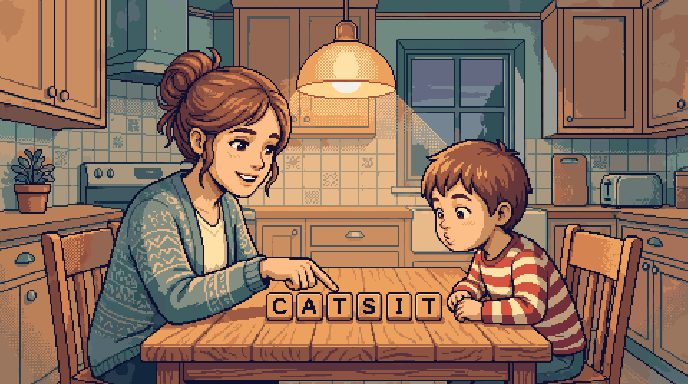
For reading difficulty, the best-evidenced approach is structured phonics instruction — explicit, systematic practice mapping sounds to letters. The Cochrane review of fourteen randomised trials concluded that "phonics training appears to be effective for improving literacy-related skills, particularly reading fluency of words and non-words, and accuracy of reading irregular words."
Note the wording. Appears to be effective. The same review adds that "more studies are needed to improve the precision of outcomes." That is a genuine finding worth acting on, not a guarantee, and anyone selling you certainty about a reading programme is going beyond what the evidence supports.
Two things follow from that. Structured phonics practice is not the same as reading together at bedtime — both are good, but only one of them is the intervention the trials tested. And a programme that promises to fix dyslexia is making a claim the research literature does not.
What you can do this term
Here the evidence stops and my opinion starts, so weigh it accordingly.
- Separate the difficulty from the effort. "You are not trying" and "this specific thing is hard for you" produce very different children five years later. If you only change one thing, change that sentence.
- Write down what you actually see, with dates. Not a diagnosis — observations. Which tasks, how long, what happened afterwards. It is the single most useful thing to bring to a teacher or an assessor, and memory alone will not survive the conversation.
- Ask what happens after the assessment, before you pursue one. Given that around a third of diagnosed children receive no specific support, the diagnosis is the beginning of the process rather than the end of it.
- Do not wait on the queue to start. If assessment is slow, blocked, or unaffordable, ask the school what literacy support they can put in place meanwhile. Structured reading intervention does not require a diagnosis to begin, and the waiting list is not neutral time.
- Protect something they are good at. A child who is struggling in one domain for six hours a day needs somewhere that is not that.
None of this is a substitute for a qualified assessment, and none of it is your fault for not having spotted sooner. The descriptions were built from a narrow sample, the assessment routes are slow, and you were told it was about effort — as most parents are.
At StuCent we build learning for the classroom as it actually is: full of children whose brains are not interchangeable, and who deserve better than being sorted by how well they match a description written for someone else.
References
- Danielson et al. (2024), ADHD prevalence among US children and adolescents in 2022 — Journal of Clinical Child & Adolescent Psychology
- ADDM Network (2023), Prevalence of autism among children aged 8 years, 2020 — MMWR Surveillance Summaries
- ADDM Network (2020), Prevalence of autism among children aged 8 years, 2016 — MMWR Surveillance Summaries
- Shaywitz & Shaywitz (2005), Dyslexia (specific reading disability) — Biological Psychiatry
- Cochrane Database of Systematic Reviews (2018), Phonics training for English-speaking poor readers
- Girls and women with autism (2019) — Psychiatria Polska
- Lai et al. (2017), Quantifying and exploring camouflaging in men and women with autism — Autism