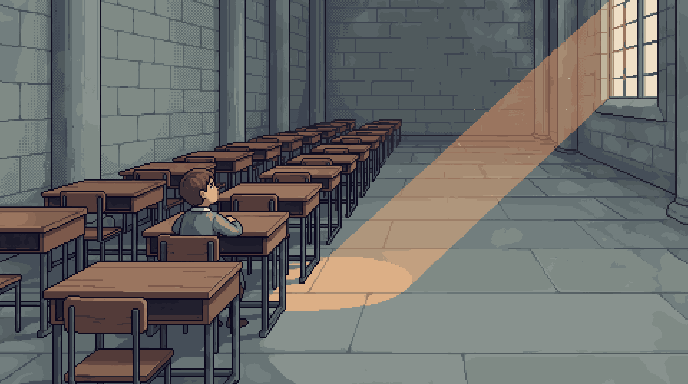
Why school feels like a factory — and who actually designed it that way
At six, your child asked why the sky goes dark. At twelve, they ask whether it is on the test.
You have probably blamed yourself for that, or blamed a teacher, or quietly wondered whether it is just what growing up does to a person. There is another possibility, and it has a paper trail.
If school feels like a factory to you — the bells, the pacing, the sense that your child is being moved along a line whether or not they are ready — you are not imagining it. But the reason is stranger, and more recent, than the story you have probably heard.
The story you have heard is wrong
You will have seen the claim: modern schools were designed by Prussian generals to manufacture obedient factory workers, and the classroom is a nineteenth-century production line that nobody got round to switching off.
Historians of education do not accept this. Sherman Dorn lists "Our current K–12 education system is based on the Industrial Age's approach to mass production" among the myths about school history. His colleagues make a sharper point about why the story is so popular: as Audrey Watters puts it, phrases like "the industrial model of education" and "the Prussian model of education" get used as a "rhetorical foil" — a way to make a political argument about the future, dressed up as a claim about the past.
The Prussian schools themselves are an awkward fit for the legend. Victor Cousin's 1837 report on Prussian education described their aim this way: "Our principal aim, in each kind of instruction, is to induce the young men to think and judge for themselves. We are opposed to all mechanical study."
That is not a description of an obedience machine. Which leaves the uncomfortable question of where the assembly line actually came from.
It did used to be a factory. Then they tore it down
Here is the part the popular story gets backwards.
Before the classroom you picture — one teacher, thirty children of the same age, desks in rows — cities ran something called the monitorial school. Dorn describes it as "a way for a single adult to supervise dozens or hundreds of students in a single large room by having high-achieving students lead smaller groups."
Hundreds of children. One adult. Older pupils drilling younger ones down the chain.
People at the time saw exactly what it resembled. Watching a monitorial school in 1820, James Cordiner wrote that "the whole is a beautiful picture of the most animated industry, and resembles the various machinery of a cloth or thread manufactory."
A cloth manufactory. Not a metaphor a critic reached for two centuries later — the admiring description of a man who liked what he saw.
And then it went away. The single-teacher, age-graded classroom, Dorn writes, "started because that classroom model replaced a true factory model in the early 19th century."
So the machine was real, and it was dismantled. What happened next is the actual story.
The blueprint: a man wrote it down in 1913
The machinery went. The mindset that built it did not, and the man who wrote it back down was not embarrassed about any of it.
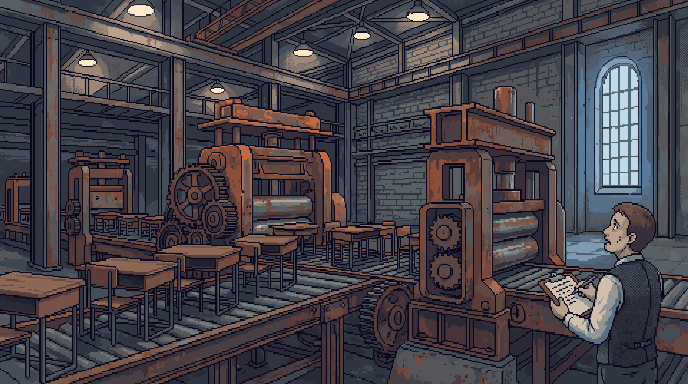
Franklin Bobbitt was a professor of educational administration at the University of Chicago, and he took Frederick Taylor's scientific management — the stopwatch-and-efficiency movement then reorganising American industry — and applied it to schooling. In 1913 he wrote:
Education is a shaping process as much as the manufacture of steel rails; the personality is to be shaped and fashioned into desirable forms.
In Bobbitt's scheme, as one curriculum textbook summarises it: "The school is compared to a factory. The child is the raw material. The adult is the finished product. The teacher is an operative, or factory worker."
Then he answered the question that matters most to you as a parent — who decides what the finished product should be:
It is the need of the world of affairs that determines the standard specification for the educational product. … Standards are to be found in the world of affairs, not in the schools.
The specification for your child is written outside the school, by the people who will eventually employ them. Teachers are contractors filling an order.
Bobbitt was clear about your standing in this, too. Deciding how education should be done, he wrote, "is a field of work in which the untrained layman can have no opinion and in which he has no right to interfere."
He meant you.
How diversity got defined out of the plan
The sentence that does the real damage is quieter. Opening his 1918 book, Bobbitt lays out his foundation:
The central theory is simple. Human life, however varied, consists in the performance of specific activities.
Watch the machinery of that sentence. "However varied" concedes that children differ — and the concession lasts three words. The main verb, "consists," then swallows it: whatever variety exists is variety of activities, and activities can be listed. From there the objectives follow, and Bobbitt wanted a great many of them: "They will be numerous, definite and particularized."
That is how difference between children stopped being something a curriculum must accommodate and became something a list could handle. Not a variety of people. A variety of tasks.
Nobody had to be hostile to your child's particular mind for any of this. It was defined away in a subordinate clause.
Why it never went away
An idea in a 1913 book is a curiosity. What makes it your problem is that Bobbitt's scheme did not stay in the book — it was taught to the next generation of people who designed curricula, and it was inherited.
Ralph Tyler went to the University of Chicago for his doctorate and trained under W. W. Charters, one of the writers a history of the period lists as "prominent writers concerned with curriculum development" alongside Bobbitt's own work. Tyler carried the objectives framework forward into the form schools still run on. Tyler's own statement of purpose keeps the logic intact: "the real purpose of education is not to have the instructor perform certain activities but to bring about significant changes in the students' pattern of behaviour." Objectives, stated in advance, in terms of measurable behaviour. As one survey of curriculum theory puts it: "From that period the work of Ralph W. Tyler, in particular, has made a lasting impression on curriculum theory and practice."
This is a line of descent, not a conspiracy. A history of school supervision notes that Bobbitt's ideas "shaped the character and nature of supervision for many years" — and my own reading, which you should weigh as interpretation rather than record, is that his model prevailed less by winning the argument than by being easier to administer than its rivals. Things that can be counted tend to beat things that cannot.
A separate movement gave uniformity something Bobbitt never bothered with: a justification. Educational essentialism, whose platform William Bagley published in April 1938, is "a relatively conservative stance to education that strives to teach students the knowledge of a society and civilization through a core curriculum," with a teacher who "is the center of the classroom, so they should be rigid and disciplinary." Essentialism was not Bobbitt's descendant — it is a different tree with similar fruit. But it explains why the common curriculum is still defended today as a virtue rather than merely a convenience.
What a blueprint cannot see
Now the part you actually notice at home.
Across a study of 797 children aged roughly 8 to 14, Mark Lepper and colleagues found that "intrinsic motivation showed a significant linear decrease from 3rd grade through 8th grade and proved positively correlated with children's grades and standardized test scores at all grade levels." The enjoyment falls year after year — and the children who keep it do better, not worse.
Rewards and pressure are the usual answer to a child who has stopped caring. They do not fill the gap. "Extrinsic motivation showed few differences across grade levels and proved negatively correlated with academic outcomes." Their conclusion is blunt: "Not only do children seem to be losing their enjoyment of the learning process itself but the systems of extrinsic incentives and constraints that American schools employ to keep students on track do not effectively compensate for the declines in intrinsic motivation. In our view, this is a real societal problem."
The authors themselves note that "these are only correlational findings." This is not proof that Bobbitt's blueprint caused your child's boredom, and anyone who tells you it is has gone further than the evidence.
Here is what the evidence actually supports, and it is about blindness. A system built to specify "numerous, definite and particularized" behaviours has no instrument that detects whether a child still wants to know things. Curiosity is not in the specification. It is not being attacked; it is not being measured, which over eleven years amounts to much the same thing.
What you can do this term
Here the history stops and my opinion starts, so weigh it as opinion.
- Stop treating the report card as the whole measurement. It is an instrument built to the specification described above, and it was never designed to detect whether your child is still curious.
- Protect one subject from assessment entirely. Something they do where no mark is attached and no adult is grading it. The evidence that intrinsic and extrinsic motivation behave differently is at least consistent with this being worth defending.
- Ask a better question after school. "What did you wonder about today" gets you different information than "how did the test go." You are, in a small way, running a measurement the system does not.
None of this fixes a hundred-year-old design, and your child's teachers are working inside the same specification you are — they did not write it either.
But it is worth knowing that the uniformity your child is being fitted into is not a discovery about how children learn. It is a design decision, made by named people, for reasons that had more to do with steel rails than with your child.
At StuCent we build learning that starts from the opposite premise: that the variety Bobbitt filed away in a subordinate clause is the point, not the problem.
References
- Educational essentialism — Wikipedia
- Schiro, Curriculum Theory, ch. 3: Social Efficiency Ideology (PDF) — Bobbitt (1913), pp. 11–12, 33–37
- Myths about the history of schools — Sherman Dorn, Arizona State University
- The Invented History of "The Factory Model of Education" — Audrey Watters
- Curriculum theory and practice — infed.org — Bobbitt (1918), Tyler (1949)
- Journal of Educational Supervision 2(1), 2019: Bobbitt and the Taylorist inheritance (PDF)
- Lepper, Corpus & Iyengar (2005), Journal of Educational Psychology 97(2), 184–196 (PDF)
- Franklin Bobbitt (1876–1956) — StateUniversity.com
- Ralph W. Tyler (1902–1994) — StateUniversity.com